
The World's Most Surveilled Cities
- Cameras Per Square Mile -
From a Chinese city you've never heard of to an Indian capital that watches its citizens more closely than anywhere else on Earth - the results of this global surveillance study will surprise you.
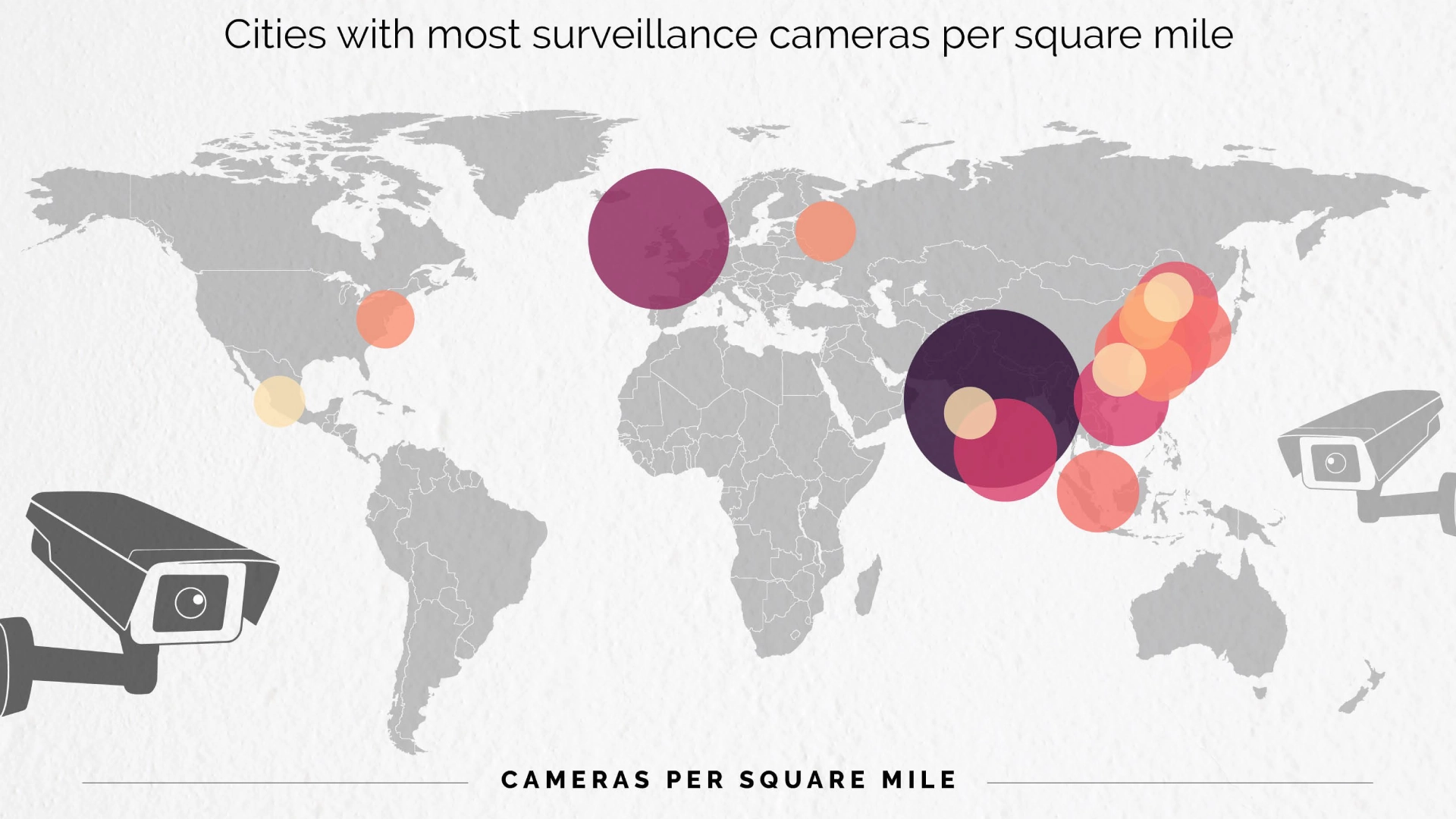
There are now an estimated one billion surveillance cameras worldwide - roughly one for every eight people. But cameras are not evenly distributed.
Some cities have invested so heavily in surveillance infrastructure that their streets are watched at a density that would have seemed like science fiction just two decades ago.
The data below comes from a Comparitech analysis of 150 cities worldwide, measuring the number of publicly known surveillance cameras per square mile (data from 2021 study).
The results contain more than a few surprises - including a city in India that beats every Chinese metropolis on the list, and a familiar Western capital that has no business being as high as it is.
Read on to find out where your city ranks.
Why CCTV Varies by City?
High camera density usually comes down to three factors - crime prevention, infrastructure management, and smart city development.
Governments deploy surveillance networks to monitor public safety, manage traffic flow, and maintain order across rapidly expanding urban populations.
In densely populated cities, cameras are as much about urban management as they are about security - tracking crowd movement, monitoring air quality, and feeding data into centralised systems that make real-time decisions about how a city functions.
Political context also plays a role. Cities in more authoritarian countries tend to invest heavily in surveillance infrastructure, while democratic nations face greater public and legal scrutiny over how cameras are used.
As this list shows, however, democracy is no guarantee of privacy - as London rather uncomfortably proves.
__________________________________________
- Cities 20 to 16 -
__________________________________________
Changchun - China 🇨🇳
- 139.6 Cameras Per Square Mile -
Changchun is the capital of Jilin Province in northeastern China, best known internationally as the former centre of Japan's wartime puppet state of Manchukuo and today as one of China's major automotive manufacturing hubs.
Its camera density of 139.6 per square mile places it at the foot of this list - but that figure still represents a level of surveillance that would rank among the highest in most Western countries.
Changchun's network is primarily focused on traffic management and public order, feeding into China's broader national surveillance infrastructure.
Even the least-watched city in this ranking is watched more closely than the vast majority of cities on Earth.
__________________________________________
Mexico City - Mexico 🇲🇽
- 151.7 Cameras Per Square Mile -
Mexico City is one of the largest urban areas on Earth, home to over 21 million people across its metropolitan area.
Its surveillance network of 151.7 cameras per square mile has expanded significantly over the past decade, driven primarily by the city's longstanding challenges with crime, kidnapping, and public safety.
The C5 command centre monitors thousands of feeds across the city in real time, making it one of the most technologically advanced urban surveillance operations in Latin America.
Mexico City is also one of only two cities in the Americas to appear in this list, the other being New York.
__________________________________________
Mumbai - India 🇮🇳
- 157.4 Cameras Per Square Mile -
Mumbai is India's financial capital and its most populous city, home to over 20 million people and the headquarters of the country's banking, film and media industries.
Its surveillance density of 157.4 cameras per square mile is driven by a combination of counter-terrorism measures - following the devastating 2008 attacks that killed 166 people - and routine urban management across one of the world's most densely populated cities.
The Mumbai Police operate one of India's most extensive integrated camera networks, with feeds monitored around the clock from centralised command facilities.
Mumbai is the first of three Indian cities to appear in this ranking - a fact that will become increasingly significant as the list progresses.
__________________________________________
Suzhou - China 🇨🇳
- 165.6 Cameras Per Square Mile -
Suzhou is one of China's wealthiest cities, situated just west of Shanghai in Jiangsu Province and famous internationally for its classical gardens, canals and silk production.
With 165.6 surveillance cameras per square mile, Suzhou's network is relatively modest by Chinese standards but still places it comfortably within the global top 20.
The city has invested heavily in smart city infrastructure, integrating its camera network with AI-powered systems capable of tracking pedestrian movement, vehicle identification and crowd density in real time.
Suzhou's classical gardens may be on the UNESCO World Heritage list, but its streets are watched just as closely.
__________________________________________
Taiyuan - China 🇨🇳
- 174.4 Cameras Per Square Mile -
Taiyuan is the capital of Shanxi Province in northern China, historically one of the country's most important coal and steel producing regions.
With 174.4 cameras per square mile, Taiyuan has consistently ranked among China's most surveilled cities relative to its population size.
Earlier versions of the Comparitech study placed Taiyuan even higher in global rankings, reflecting the city's early and aggressive investment in public surveillance infrastructure.
It remains a city largely unknown by many, yet its streets are watched at a density that exceeds many of the world's most famous capitals.
__________________________________________
- Cities 15 to 11 -
__________________________________________
Beijing - China 🇨🇳
- 181.5 Cameras Per Square Mile -
Beijing is China's capital and political heart, home to 21 million people and the seat of the Chinese Communist Party.
Its surveillance density of 181.5 cameras per square mile is perhaps lower than many people would expect for a city of such political significance - but the figure reflects only publicly documented cameras, and Beijing's true surveillance infrastructure is widely believed to extend far beyond what is officially acknowledged.
The city's network integrates facial recognition, gait recognition and voice recognition technology, making it one of the most technologically sophisticated surveillance environments on Earth.
During the 2022 Winter Olympics, Beijing's camera network was extended and upgraded significantly to monitor athletes, officials and the public simultaneously.
__________________________________________
New York - USA 🇺🇸
- 193.7 Cameras Per Square Mile -
New York City is the only American city to appear in this global top 20, and its presence here will surprise many people who associate mass surveillance primarily with authoritarian governments.
With 193.7 cameras per square mile, New York's network includes approximately 12,000 publicly operated cameras alongside an estimated tens of thousands of privately owned cameras in commercial and residential buildings.
The Lower Manhattan Security Initiative, modelled partly on London's Ring of Steel, monitors the city's financial district with particular intensity.
Following the September 11 attacks, New York invested heavily in surveillance infrastructure that has continued to expand ever since.
The average New Yorker is estimated to be captured on camera hundreds of times per day.
__________________________________________
Moscow - Russia 🇷🇺
- 210.0 Cameras Per Square Mile -
Moscow operates one of the largest urban surveillance networks in Europe, with 210 cameras per square mile monitoring a city of over 12 million people.
The Russian capital expanded its camera infrastructure dramatically in the years leading up to and during the COVID-19 pandemic, when facial recognition technology was used to identify and fine residents who violated lockdown restrictions - a use of surveillance technology that drew significant international criticism.
Moscow's network is operated by the city government and integrated with the Russian federal security apparatus.
During major political events and protests, the camera network has been used to identify and subsequently arrest demonstrators.
__________________________________________
Xiamen - China 🇨🇳
- 228.7 Cameras Per Square Mile -
Xiamen is a coastal city in Fujian Province in southeastern China, one of the country's original Special Economic Zones and today a major centre for trade, technology and tourism.
Its surveillance density of 228.7 cameras per square mile reflects both its economic importance and its geographic sensitivity - Xiamen sits directly across the Taiwan Strait from Taiwan, making it one of China's most geopolitically significant coastal cities.
The city was among the first in China to deploy AI-powered cameras capable of publicly shaming jaywalkers by displaying their faces on large digital screens at intersections - a system that has since been adopted across dozens of other Chinese cities.
__________________________________________
Seoul - South Korea 🇰🇷
- 331.9 Cameras Per Square Mile -
Seoul is the first non-Chinese Asian city to appear in the upper half of this ranking, with 331.9 surveillance cameras per square mile monitoring a metropolitan population of over 25 million people.
South Korea has embraced surveillance technology partly as a function of its unique geopolitical position - the country remains technically at war with North Korea, and security consciousness is deeply embedded in national infrastructure planning.
Seoul's camera network is also used extensively for traffic management, crime prevention and, during the COVID-19 pandemic, contact tracing.
South Korea's government has been notably transparent about its surveillance infrastructure compared to many other countries in this list.
__________________________________________
- Entries 10 to 6 -
__________________________________________
Wuhan - China 🇨🇳
- 339 Cameras Per Square Mile -
Wuhan entered the global consciousness in late 2019 and early 2020 as the city where the COVID-19 pandemic first emerged, and its surveillance infrastructure played a significant role in the Chinese government's response to the outbreak.
With 339 cameras per square mile, Wuhan's network was used to enforce quarantine measures, track the movement of residents and identify individuals not wearing masks in public spaces.
The city of 11 million people had already invested heavily in smart city surveillance technology before the pandemic, and the crisis accelerated further expansion of its camera network.
Wuhan's experience became a reference point in global debates about the use of surveillance technology during public health emergencies.
__________________________________________
Changsha - China 🇨🇳
- 353.9 Cameras Per Square Mile -
Changsha is the capital of Hunan Province in south-central China, a city of eight million people that has emerged as one of China's fastest-growing technology and media hubs over the past decade.
Its surveillance density of 353.9 cameras per square mile places it firmly in the top half of this global ranking.
Changsha is home to several of China's largest technology companies involved in AI development, and the city has been used as a testing ground for next-generation surveillance systems including cameras capable of identifying individuals by their walking gait alone - a technology that can track people even when their faces are obscured or turned away from the camera.
__________________________________________
Singapore 🇸🇬
- 387.6 Cameras Per Square Mile -
Singapore is the smallest nation-state in this ranking and the only one to appear as an entire country rather than a single city - because Singapore is both.
With 387.6 surveillance cameras per square mile, the city-state operates one of the most sophisticated and densely deployed camera networks in the world.
Singapore's government has been open about its surveillance ambitions, describing a long-term plan to equip every lamp post in the country with sensors and cameras as part of its Smart Nation initiative.
The country already uses cameras extensively for traffic enforcement, border control and public safety, and its facial recognition capabilities are among the most advanced of any government in the world.
__________________________________________
Shanghai - China 🇨🇳
- 408.5 Cameras Per Square Mile -
Shanghai is China's largest city and its financial capital, home to 24 million people and one of the busiest ports on Earth.
With 408.5 surveillance cameras per square mile, Shanghai operates a camera network of staggering scale - the city alone is estimated to have over 2.9 million cameras installed across its urban area, making it one of the highest absolute totals of any city in the world.
Shanghai's surveillance system integrates traffic monitoring, facial recognition, commercial security and public safety feeds into a unified network monitored by the city's public security bureau.
During Shanghai's controversial two-month COVID-19 lockdown in 2022, the camera network was used extensively to enforce restrictions on movement.
__________________________________________
Qingdao - China 🇨🇳
- 415.8 Cameras Per Square Mile -
Qingdao is a coastal city in Shandong Province in eastern China, best known internationally as the home of Tsingtao beer and as the sailing venue for the 2008 Beijing Olympics.
With 415.8 cameras per square mile, Qingdao's surveillance density exceeds that of Shanghai despite having roughly half the population, making it one of the more intensively monitored cities in China relative to its size.
The city has invested significantly in maritime surveillance technology given its importance as a major naval base and commercial port, with cameras monitoring both its urban streets and its extensive coastline.
Qingdao's camera network is integrated with China's broader Skynet surveillance programme.
__________________________________________
- Cities 5 to 1 -
__________________________________________
Wuxi - China 🇨🇳
- 472.7 Cameras Per Square Mile -
Wuxi is a prosperous industrial city in Jiangsu Province, situated between Shanghai and Nanjing on the shores of Lake Tai.
With 472.7 cameras per square mile it ranks fifth in this global list, a remarkable figure for a city that most people outside China would struggle to place on a map.
Wuxi has positioned itself as one of China's leading smart city test beds, with its surveillance infrastructure serving as a showcase for integrated AI-driven urban management.
The city's camera network monitors everything from traffic flow and air quality to the behaviour of pedestrians in public spaces, with data fed in real time to municipal authorities.
Wuxi is a glimpse of what urban surveillance looks like when it is treated not as a security measure but as a governing philosophy.
__________________________________________
Shenzhen - China 🇨🇳
- 520.1 Cameras Per Square Mile -
Shenzhen is one of the most remarkable cities on Earth - transformed in four decades from a small fishing village into a metropolitan area of 17 million people and one of the world's leading technology manufacturing hubs.
With 520.1 cameras per square mile it ranks fourth globally, and given that Shenzhen is home to companies like Huawei, DJI and Tencent, it is perhaps unsurprising that its streets serve as a live laboratory for the surveillance technology its residents help to build.
Shenzhen was one of the first cities in China to use AI cameras to publicly identify and shame jaywalkers, and its facial recognition network is considered one of the most accurate and comprehensive of any city in the world.
__________________________________________
Chennai - India 🇮🇳
- 609.9 Cameras Per Square Mile -
Chennai is the capital of Tamil Nadu in southern India and the country's fourth largest city, home to over 10 million people and a major centre for automotive manufacturing, technology and film production.
With 609.9 cameras per square mile, Chennai ranks third in the world - a figure that surprises almost everyone who encounters it for the first time.
India's southern cities have invested particularly heavily in surveillance infrastructure following a series of security incidents in the 2000s and 2010s, and Chennai's network is one of the most extensive in South Asia.
The city's cameras are monitored from a centralised command and control facility that operates around the clock, with feeds covering major roads, railway stations, markets and public gathering spaces.
__________________________________________
London - UK 🇬🇧
- 1,138.5 Cameras Per Square Mile -
London is the highest-ranked Western city in this list by an enormous margin, and its presence at number two will confirm what many Britons have long suspected - that they live in one of the most watched cities on Earth.
With 1,138.5 cameras per square mile, London has more than double the camera density of Chennai in third place, and nearly six times the density of New York in fourteenth.
The UK capital has an estimated 630,000 cameras across Greater London, with the City of London financial district alone operating 75 cameras per 1,000 residents - the highest concentration of any area in the country.
London's surveillance network has expanded continuously since the IRA bombings of the 1980s and 1990s, accelerating further after the July 2005 terrorist attacks.
The average Londoner is estimated to be captured on camera over 300 times per day.
__________________________________________
Delhi - India 🇮🇳
- 1,826.6 Cameras Per Square Mile -
Delhi is the most surveilled city on Earth.
With 1,826.6 cameras per square mile, India's capital beats every Chinese city in this ranking, surpasses London by a significant margin, and operates a camera density so far beyond the rest of the world that it sits in a category of its own.
Delhi's surveillance network has expanded explosively over the past decade, driven by the city's serious and longstanding challenges with crime, public safety and the security demands of a capital city that hosts the headquarters of the Indian government, parliament and military.
The Delhi Police operate one of the largest integrated camera networks of any police force in the world, with feeds monitored from a central command facility.
The network uses facial recognition technology and is connected to national criminal databases, allowing real-time identification of individuals of interest.
That Delhi - not Beijing, not Shanghai, not London - sits at the top of this list is perhaps the most surprising finding of the entire study.
__________________________________________
The data in this article is sourced from Comparitech's analysis of surveillance cameras in 150 cities worldwide, figures as of May 2021.
Camera counts reflect publicly known installations and are likely to underrepresent the true total in all cities listed, particularly those where government transparency around surveillance infrastructure is limited.
Explore live cameras from cities around the world on our Live Webcam Map, or browse feeds by country and interest at EarthLive.TV.
Or, if you are feeling nerdy, check out our tech guide on How Webcams Actually Work!
Next Up: Best Live Webcam Categories to Watch Right Now (2026 Guide)
Or Read: Are Live Webcams The Future of Travel? OR The Dark Side of Live Webcams: Privacy, Risks & Reality.
__________________________________________