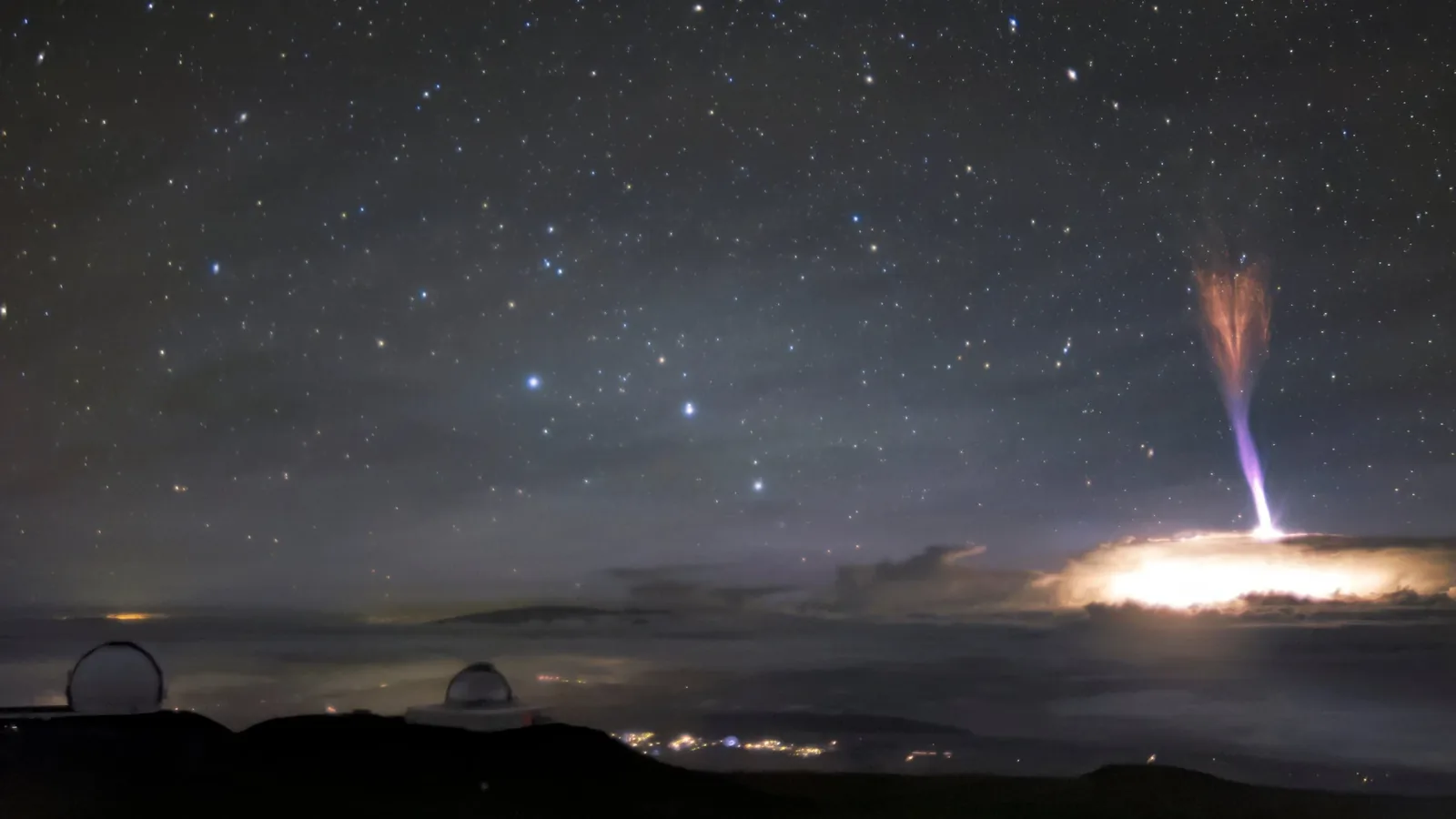
On July 24, 2017, an automatic camera at an observatory on Maunakea, Hawaii, in the United States, caught something most people will never see: a flash of red and blue light high above a distant thunderstorm, near the edge of space.
Most lightning stays inside clouds or strikes the ground. But above and around storms, there’s a whole family of stranger flashes. Many last only a few thousandths of a second, and some are rarely seen with the naked eye.
This list mixes rare forms of lightning with related flashes of light in the upper atmosphere, which scientists call transient luminous events. The order isn’t a ranking. These events are counted in very different ways, so nobody can say for sure which is truly the rarest.
#7 Volcanic Lightning
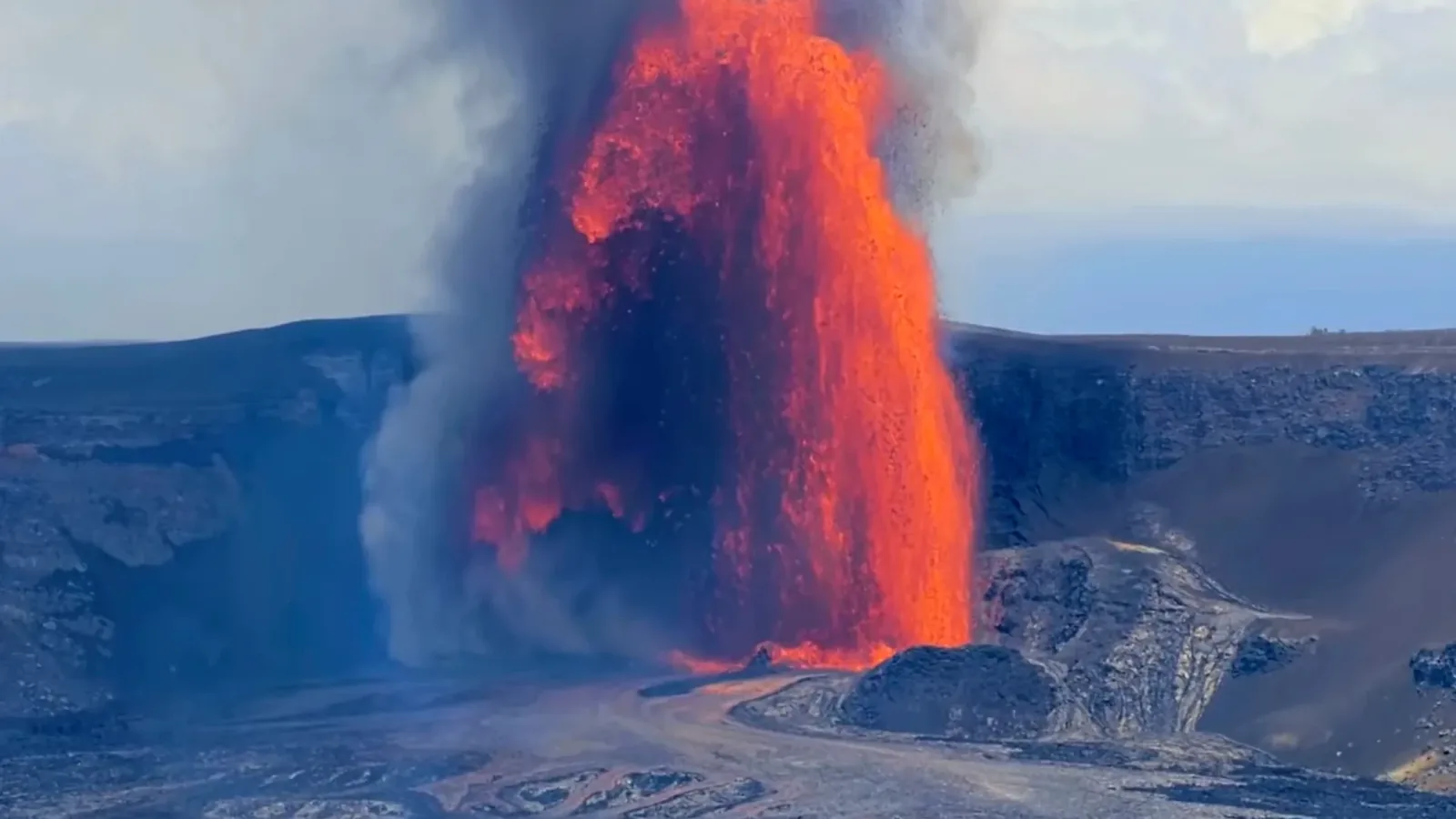
When a volcano erupts violently, its ash cloud can make its own lightning, with no thunderstorm needed. Countless particles of ash and rock collide as they’re blasted upward, building up electric charge.
Higher in the plume, ice can form and add to the charging, much as it does in an ordinary storm cloud.
It has been photographed over Iceland’s Eyjafjallajökull in 2010 and Chile’s Calbuco in 2015, and it flickers regularly over Sakurajima in Japan, one of the world’s most active volcanoes.
The record breaker: The January 2022 eruption of Hunga Tonga–Hunga Ha’apai in the South Pacific produced the most intense lightning ever recorded. Researchers counted nearly 200,000 flashes, at a peak of more than 2,600 a minute.
LIVEWatch live →#6 Megaflashes
Most lightning flashes are a few miles long. Megaflashes are single flashes that sprawl sideways through huge storm systems for hundreds of miles.
The longest on record: In July 2025, the World Meteorological Organization certified a megaflash of about 515 miles (829 km) over the US Great Plains on October 22, 2017, stretching from eastern Texas to near Kansas City. That’s roughly the distance from Paris to Venice.
It wasn’t one straight bolt. The 515 miles is the horizontal reach of a single flash as it spread through the storm system, and it was only identified when satellite data was re-examined years later.
The longest lasting: A separate record flash lit up the sky over Uruguay and northern Argentina for 17.102 seconds on June 18, 2020.
LIVEWatch live →#5 Red Sprites
Sprites appear high above thunderstorms, about 30 to 55 miles (50 to 90 km) up, separate from the cloud below. They glow red at the top, often with bluish tendrils hanging underneath, and come in several shapes, including jellyfish, columns and carrots.
They’re usually linked to unusually powerful positive cloud-to-ground lightning, which sends a surge of energy upward. They typically last from a few to several tens of thousandths of a second.
Caught by accident: Pilots had reported odd flashes above storms for decades, but sprites weren’t photographed until 1989, when University of Minnesota scientists captured one while testing a low-light camera.
LIVEWatch live →#4 Blue Jets
Blue jets don’t hang above the storm. They shoot up out of it, bursting from the top of a thundercloud as a narrow blue cone and climbing to around 25 to 30 miles (40 to 50 km).
They were first filmed in 1994, from aircraft flying over thunderstorms.
Seen from space: On February 26, 2019, an instrument on the International Space Station recorded a blue jet over the Pacific Ocean. It began with an intensely bright flash lasting about 10 millionths of a second, which researchers nicknamed a “blue bang”. The study was published in 2021.
LIVEWatch live →#3 Gigantic Jets
Gigantic jets resemble blue jets but extend much higher. They rise out of the storm as a blue column, then branch into red tendrils near the top, typically reaching about 45 to 55 miles (70 to 90 km) up, and sometimes higher. In effect, they connect a thunderstorm to the ionosphere, the electrically charged layer at the edge of space.
The first was recorded in 2001 from Arecibo Observatory in Puerto Rico. Most happen over warm tropical oceans, and estimates range from a few thousand to more than 50,000 a year, yet only a small fraction are recorded.
The most powerful: On May 14, 2018, a gigantic jet over southwestern Oklahoma carried about 300 coulombs of electric charge into the upper atmosphere, more than double the previous record for a jet. Scientists mapped it in 3D for the first time using radio antennas on the ground and a weather satellite.
Why they’re so hard to film: From the ground, a storm’s own cloud usually blocks the view of its top. To photograph a jet, it helps to have dark skies and a clear view above a distant storm.
That’s why mountaintop observatories, which sit above most clouds with cameras watching the sky all night, have caught some of the best footage.
#2 ELVES
ELVES may be the strangest flashes of all. The name stands for Emission of Light and Very Low Frequency perturbations due to Electromagnetic Pulse Sources.
When a powerful lightning strike releases a burst of radio energy, it heats a thin layer of the upper atmosphere about 55 miles (90 km) up and makes it glow, a little below where the aurora shines. The glow spreads outward as an expanding ring that can grow more than 200 miles (300 km) wide, all in less than a thousandth of a second.
Too fast to see: That speed is why ELVES are rarely seen with the naked eye. They were first identified in video recorded from the Space Shuttle, in a study published in 1992.
Satellite studies have since found that ELVES are actually the most common transient luminous event. They’re rare to see, not rare to happen.
LIVEWatch live →#1 Ball Lightning
For centuries, people have described glowing balls drifting through the air during thunderstorms, sometimes even indoors, lasting a few seconds before fading or popping. For a long time, many scientists doubted the reports.
Recorded by chance: In July 2012, researchers studying ordinary lightning on the Qinghai Plateau in northwest China recorded a glowing ball about 3,000 feet (900 meters) away, just after a strike hit the ground. It lasted about 1.6 seconds, and their instruments picked up silicon, iron and calcium, elements found in soil. The study was published in 2014.
That fits one theory: lightning vaporizes soil, and the vapor burns as a floating, glowing ball. But it’s a single recording, and there’s still no universally accepted explanation. Other ideas involve trapped microwaves or charged bubbles of plasma.
Most evidence for ball lightning is still eyewitness accounts and videos that can’t be checked. Some well-known clips online have turned out to be computer-generated, so footage needs to be treated with caution.
In one widely shared clip from a storm in Alberta, Canada, a scientist told Global News the glowing object could be a rare ball lightning event. Like most such videos, it hasn’t been confirmed.
LIVEWatch live →The Sky Above the Storm
Most of these flashes were only confirmed in the last 40 years, several of them by accident, on cameras pointed at something else.
Today, amateur photographers, observatories and satellites catch them more often than ever, and each recording helps explain how thunderstorms connect to the edge of space.
For more of what’s happening above our heads, explore our sky cams and the night sky live, find out where and when to see the northern lights, see what would happen if the Yellowstone supervolcano erupted, or meet the most extreme live webcams on Earth.
 Take Me Anywhere
Sources 18
- World Meteorological Organization (2025) - WMO certifies megaflash lightning record in USA
- USGS (2023) - Tonga’s Hunga eruption produced the most intense lightning ever recorded
- AGU (2023) - Tonga’s Hunga eruption produced the most intense lightning ever recorded
- Scientific American (2016) - What causes eerie volcanic lightning?
- Franz, Nemzek and Winckler (1990) - Television image of a large upward electrical discharge above a thunderstorm system, Science
- Wescott et al. (1995) - Preliminary results from the Sprites94 aircraft campaign: 2. Blue jets, Geophysical Research Letters
- ESA (2021) - Genesis of blue lightning into the stratosphere detected from the International Space Station
- Neubert et al. (2021) - Observation of the onset of a blue jet into the stratosphere, Nature
- Pasko et al. (2002) - Electrical discharge from a thundercloud top to the lower ionosphere, Nature
- Boggs et al. (2022) - Upward propagation of gigantic jets revealed by 3D radio and optical mapping, Science Advances
- Eos (2022) - Gigantic jet of lightning mapped over Oklahoma
- NOIRLab (2021) - Lightning Strikes Up (image of the week)
- Boeck et al. (1992) - Lightning induced brightening in the airglow layer, Geophysical Research Letters
- Fukunishi et al. (1996) - Elves: lightning-induced transient luminous events in the lower ionosphere, Geophysical Research Letters
- Chen et al. (2008) - Global distributions and occurrence rates of transient luminous events, Journal of Geophysical Research
- NASA Earthdata - Space Shuttle lightning experiments
- Cen, Yuan and Xue (2014) - Observation of the optical and spectral characteristics of ball lightning, Physical Review Letters
- APS Physics (2014) - First spectrum of ball lightning
Editor's note
This list mixes rare forms of lightning with related transient luminous events in the upper atmosphere, and the countdown order is for storytelling, not a ranking of rarity. Figures for megaflashes and the Hunga Tonga eruption come from satellite and ground-based lightning networks. Ball lightning remains unexplained, and the Alberta video shows a possible event that has not been confirmed. Some clips are slowed down or time-lapsed. NOIRLab describes the cover photo as a red sprite, while other sources identify it as a gigantic jet, so our caption names neither.
How we researched this article
We used the World Meteorological Organization's record certifications, USGS and AGU reports on the Hunga Tonga eruption, NOIRLab, ESA and NASA records, and the original studies on sprites, blue jets, gigantic jets, ELVES and the 2012 ball lightning recording.