The average depth of the ocean is about 3,682 metres. Almost none of it has ever been seen by a human being.
What follows is a descent. We start at the surface, where nearly everything you can name lives, and keep going until the fish run out, and then keep going after that.
One thing to hold onto on the way down: very few animals live at a single depth. Many move huge distances every day, so where a creature appears below is where it’s reliably found, not a line it never crosses.
Sunlight Zone: 0 - 200m
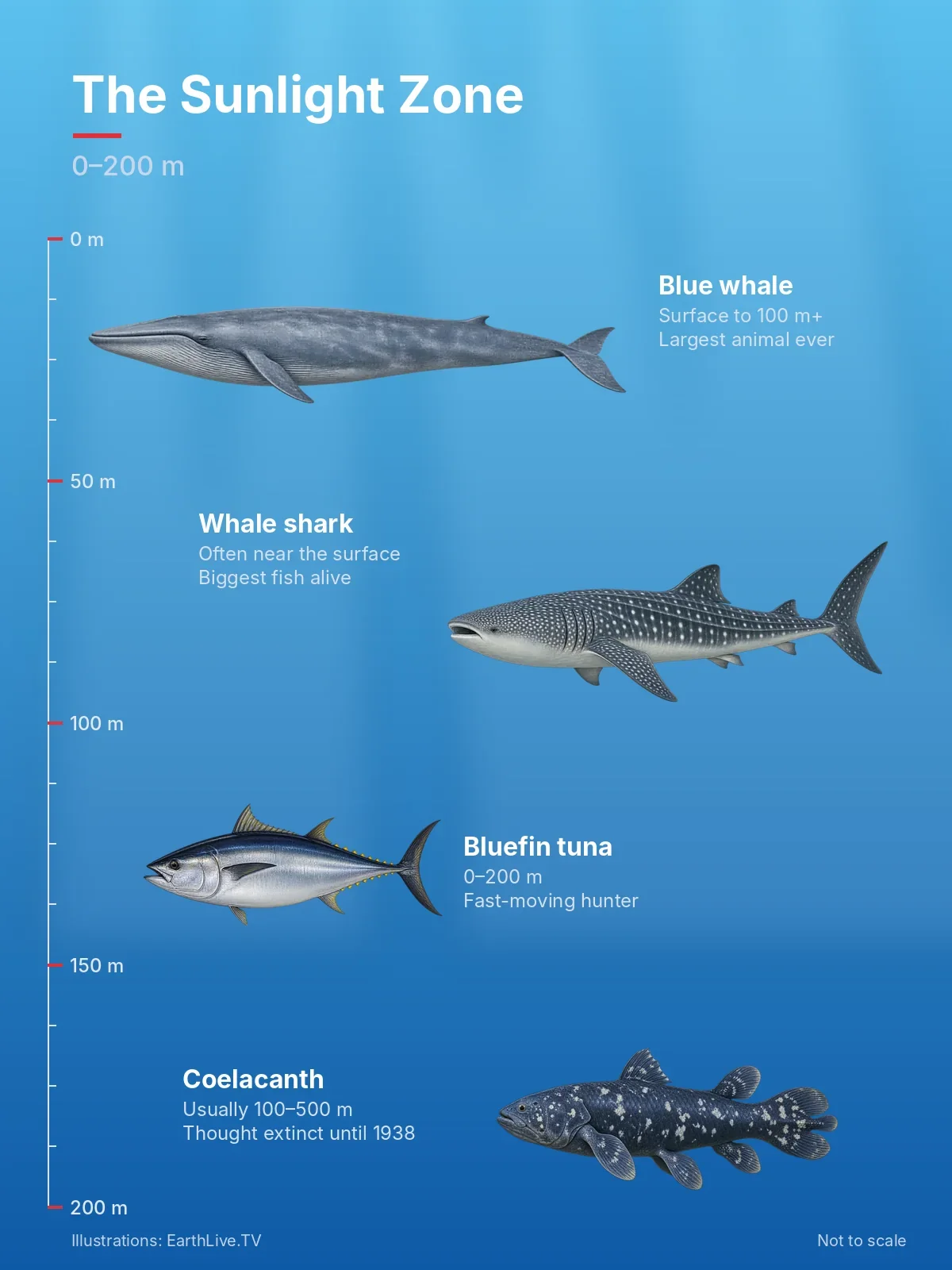
Illustration: EarthLive.TV
The upper 200 metres or so holds enough light for photosynthesis. Most life deeper down depends, one way or another, on what falls from here.
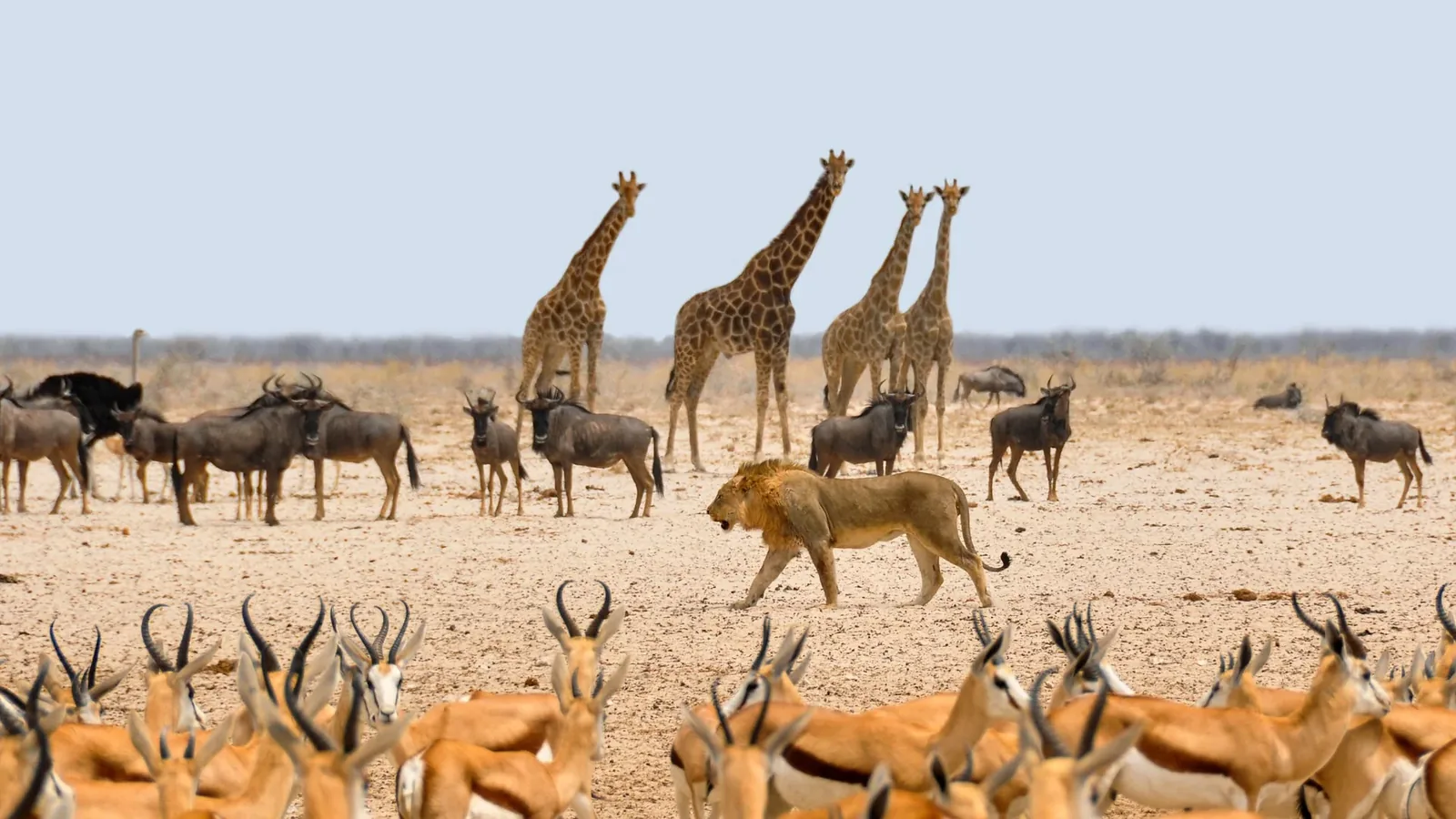
This is where the ocean puts its spectacle: blue whales, whale sharks, tuna, coral reefs and kelp forests, and the overwhelming majority of marine species. The blue whale is the heaviest animal ever known, outweighing even the biggest dinosaurs.
So take one that shouldn’t be here at all. The coelacanth belongs to a lineage known from fossils hundreds of millions of years old, and was thought to have vanished tens of millions of years ago.
Then, in 1938, a South African trawler landed a living one. It lives in rocky caves, mostly a few hundred metres down. It isn’t unchanged, but the lineage was quietly still there the whole time.
You can watch sunlit-zone life live:
LIVEWatch live →LIVEWatch live →Twilight Zone: 200 - 1,000m
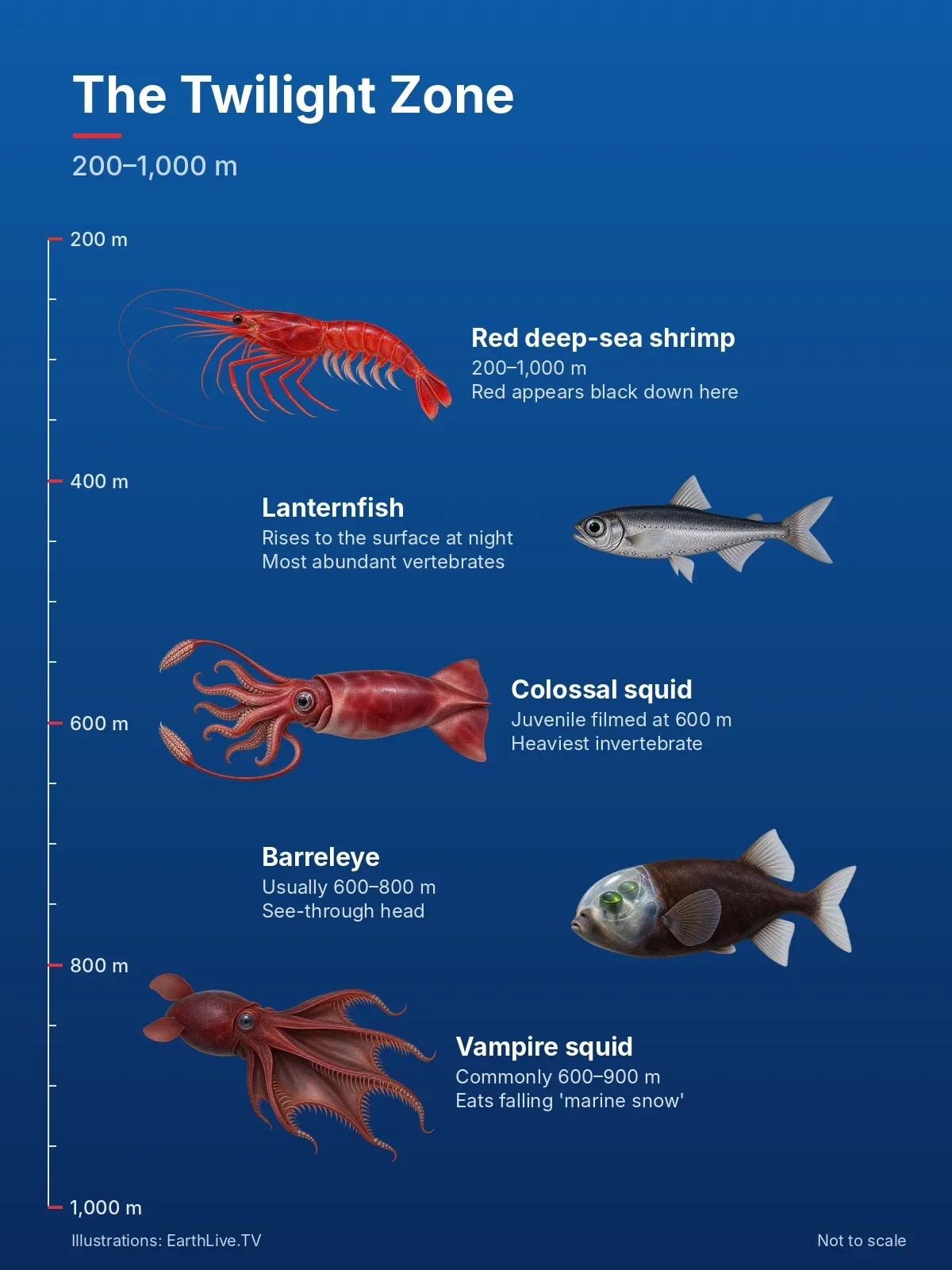
Illustration: EarthLive.TV
Below 200 metres the light thins and turns blue, because seawater absorbs red first. It can be detected down to around 1,000 metres, but there’s nowhere near enough for photosynthesis.
That makes red a camouflage. With no red light left to reflect, a red shrimp at 600 metres looks black.
Every night, vast numbers of lanternfish, shrimp and squid rise toward the surface to feed, then sink back before dawn. It’s the largest migration on Earth. Sonar operators in the 1940s mistook this living layer for the seafloor and called it the false bottom.
The barreleye has a completely transparent head, with tubular eyes that rotate inside it to look up for silhouettes.
The vampire squid, despite its name, doesn’t hunt. It drifts in low-oxygen water collecting marine snow, the slow fall of dead plankton and waste from above.
In March 2025, the Schmidt Ocean Institute’s ROV SuBastian filmed a juvenile colossal squid at 600 metres, the first confirmed video of the species alive in its natural habitat. Adults are thought to reach around seven metres and 500 kilograms, the heaviest invertebrates on Earth.
You can watch SuBastian’s dives live:
LIVEWatch live →Midnight Zone: 1,000 - 4,000m
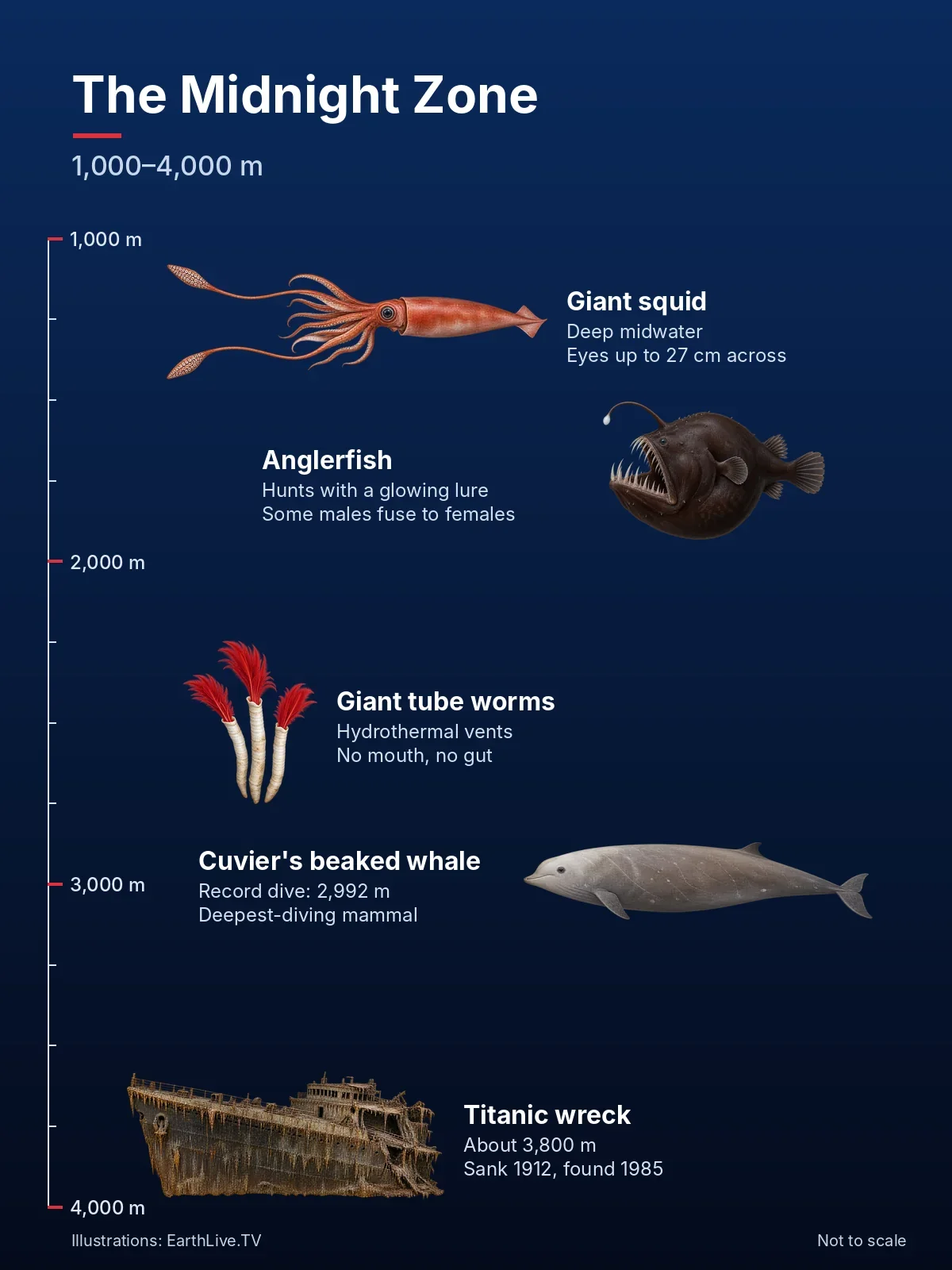
Illustration: EarthLive.TV
By around 1,000 metres, sunlight is gone. The only light down here is the light animals make themselves.
Anglerfish hunt with a glowing lure lit by bacteria. In many species the tiny male bites onto a female and never lets go: his body fuses with hers, and he becomes a permanent attachment.
The giant squid’s reputation outruns the evidence. The biggest specimens scientists have actually examined reach about 13 metres, mostly two long feeding tentacles. It does have the largest eyes of any known animal, around 27 centimetres across.
This is also as deep as any air-breathing animal is known to go. A Cuvier’s beaked whale holds the record at 2,992 metres, set off southern California and published in 2014.
Not everything here lives off food from above. In 1977, scientists found hydrothermal vents about 2,500 metres down, with giant tube worms up to three metres long that have no mouth and no gut. Bacteria inside them turn chemicals from the vents into food, life running without the sun.
The Titanic lies in this zone too, about 3,800 metres down, unseen from 1912 until 1985.
Abyss: 4,000 - 6,000m
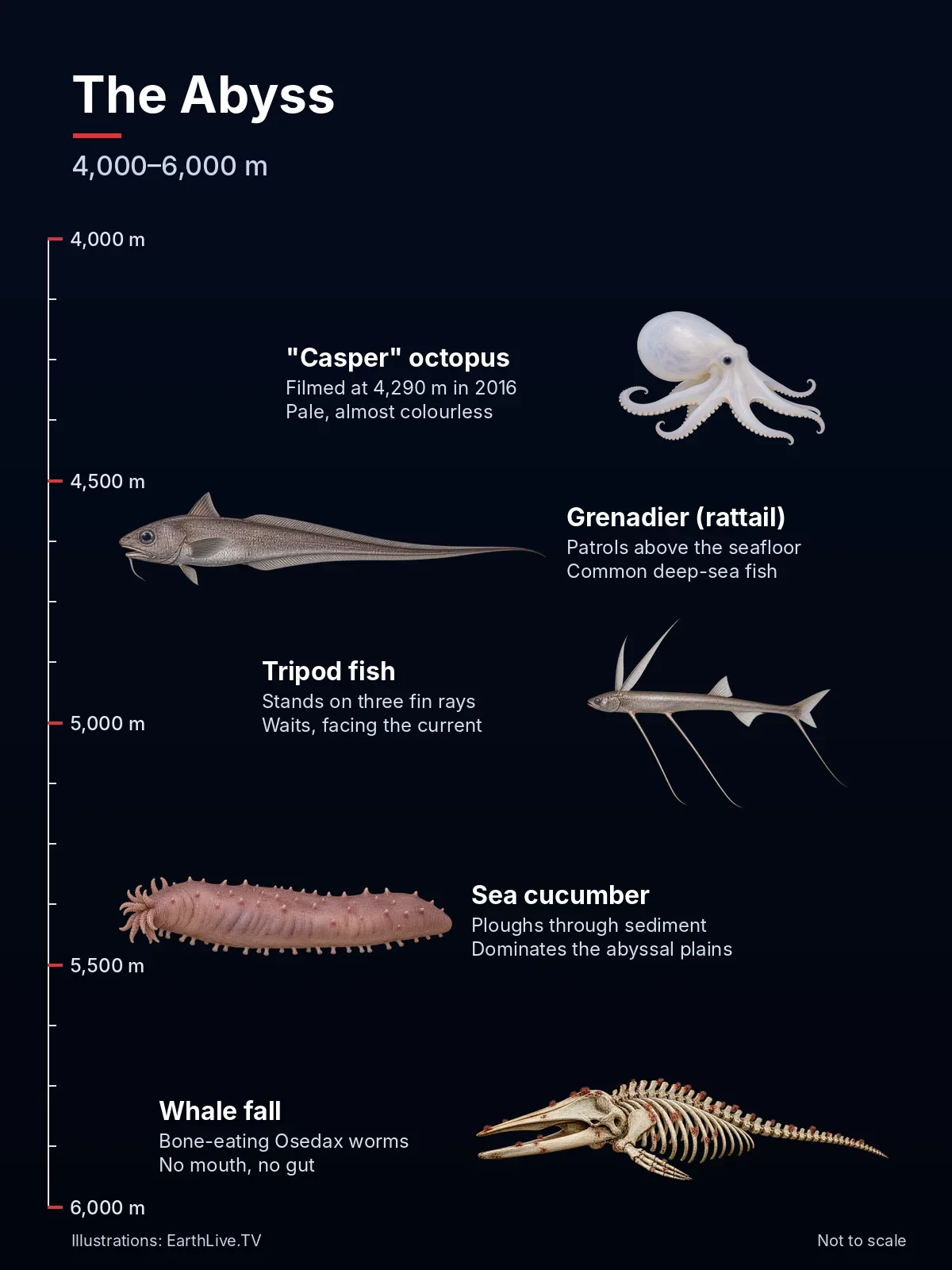
Illustration: EarthLive.TV
Below 4,000 metres the water is just above freezing, and the seafloor spreads into the abyssal plains, some of the flattest, least explored terrain on Earth.
Somewhere between about 4,000 and 5,000 metres, shells and skeletons made of calcium carbonate start to dissolve faster than they build up, making them harder to keep. Sea cucumbers often dominate here, ploughing through sediment for scraps that have drifted down from far above.
Tripod fish perch on three long fin rays like a camera on a stand, facing into the current and waiting. Grenadiers patrol just above them.
In 2016, a small, almost colourless octopus was filmed at 4,290 metres in the Pacific and promptly nicknamed Casper. At the time, it was the deepest sighting ever of an unfinned octopus.
When a whale dies and sinks this deep, it can feed an ecosystem for decades. Scavengers strip the flesh, then Osedax worms bore into the bones to reach the fat inside. They have no mouth, no gut and no anus, and were only described in 2004.
Hadal Zone: 6,000 - 8,400m
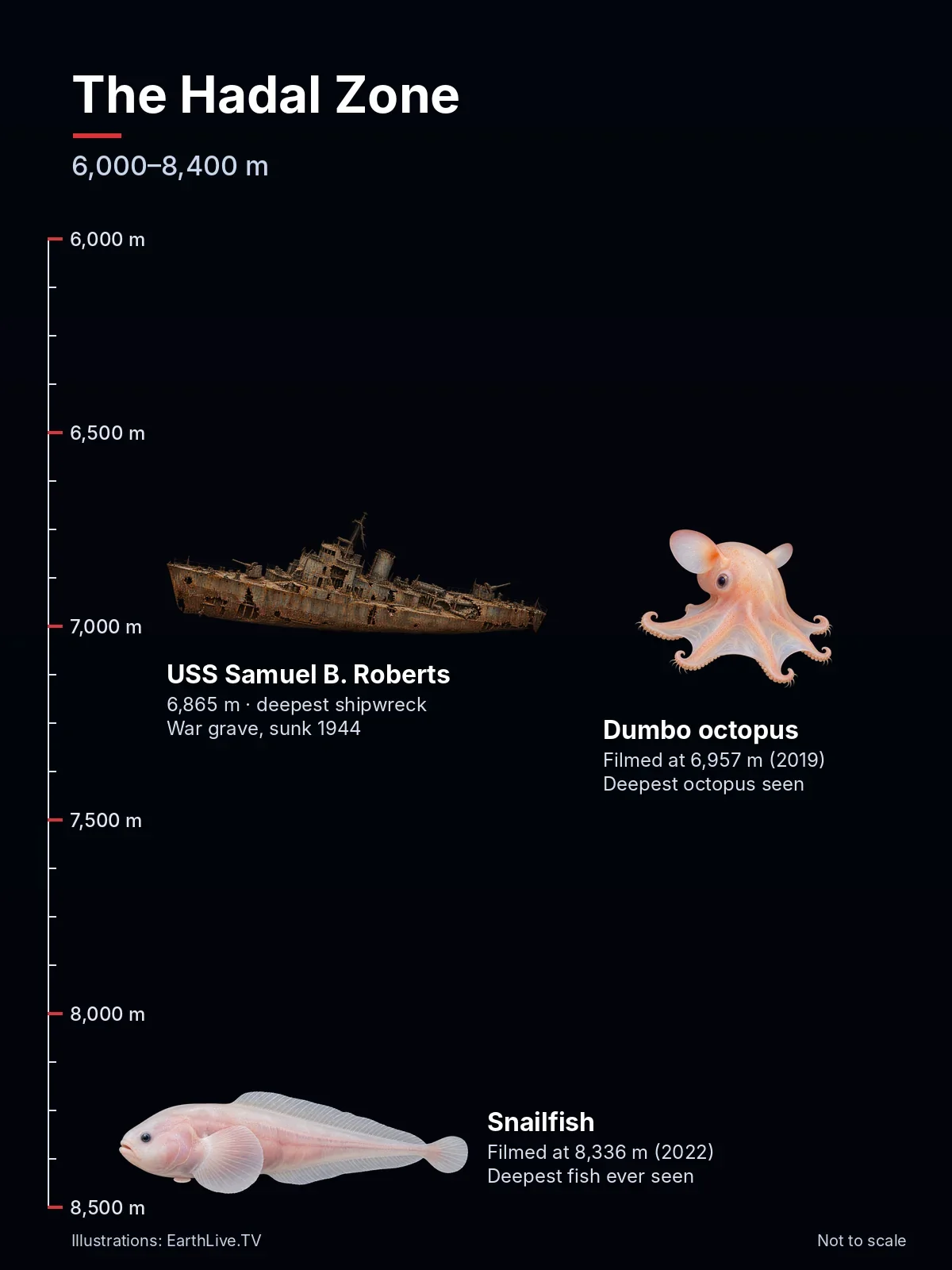
Illustration: EarthLive.TV
Past 6,000 metres you’ve almost always left the open seafloor behind. The hadal zone, named after Hades, exists mostly in deep trenches, isolated gashes in the ocean floor, which is why it’s so poorly explored.
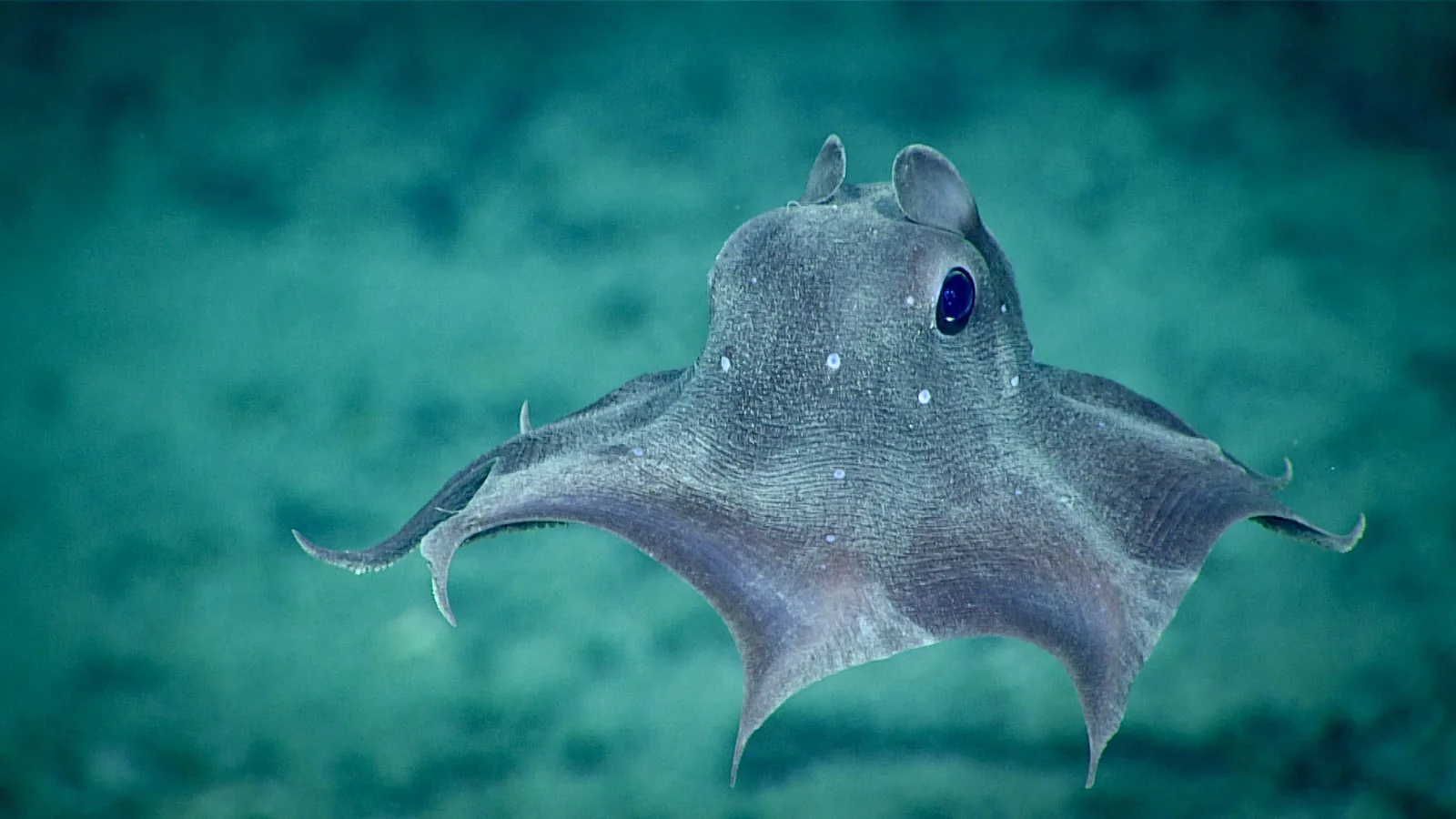
In 2019, a camera in the Java Trench filmed a dumbo octopus at 6,957 metres, more than 1,800 metres deeper than any octopus or squid seen before.
Then the fish start to thin out. Snailfish are the deepest fish ever recorded: small, pale and jelly-like, with no swim bladder to be crushed. In 2022, one was filmed at 8,336 metres in the Izu-Ogasawara Trench off Japan.
Scientists think something stops fish at around 8,200 to 8,400 metres. Exactly what is still being worked out.
The deepest shipwreck ever found is here too. The USS Samuel B. Roberts, sunk in 1944, lies at 6,865 metres in the Philippine Sea. It’s a war grave, and its exact location has not been released.
Past the Fish: 8,400 - 10,935m
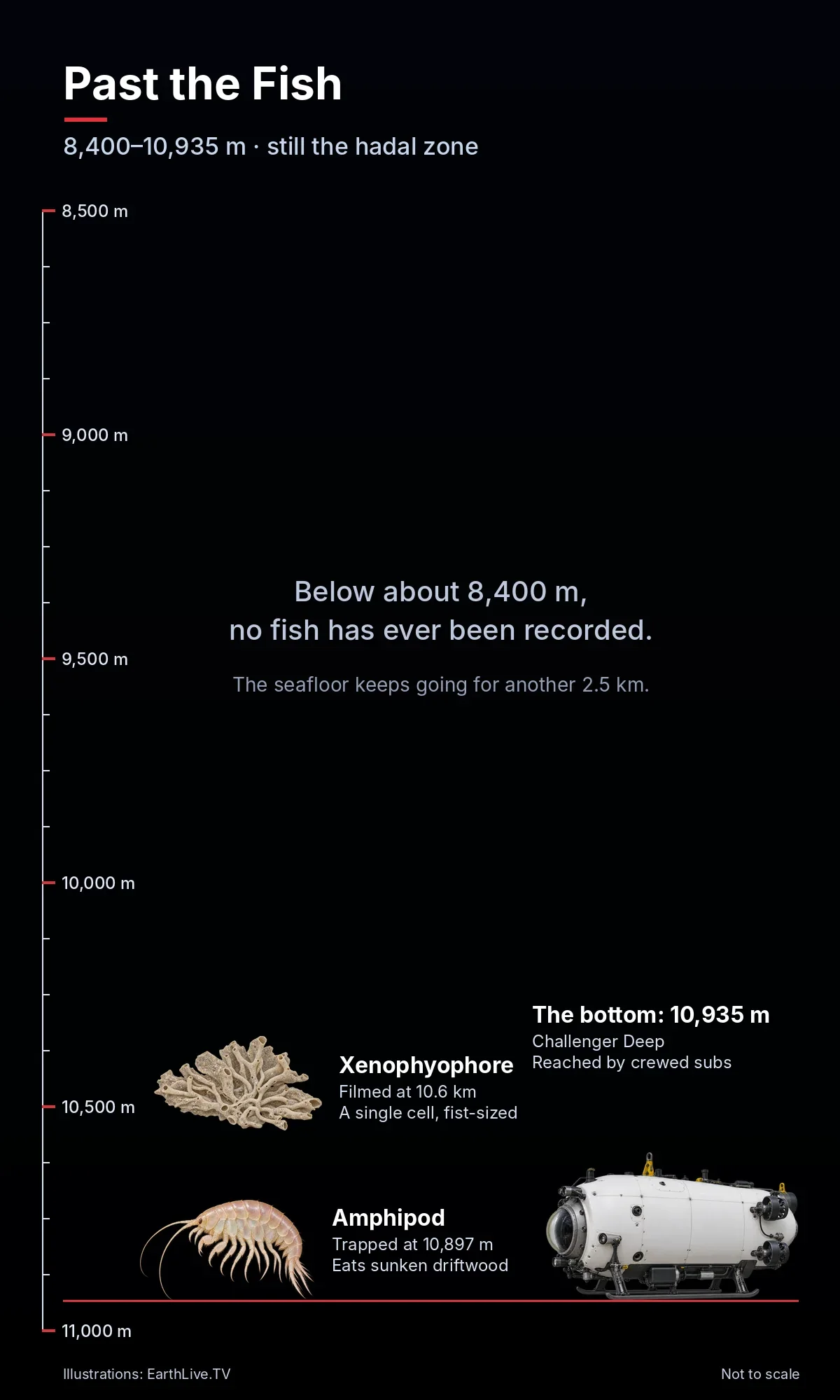
Illustration: EarthLive.TV
We’re still in the hadal zone, which runs all the way to the bottom. But below about 8,400 metres, no fish has ever been recorded. At the Challenger Deep, the seafloor keeps going for another two and a half kilometres.
Among the animals that live there are amphipods, small scavenging crustaceans two to five centimetres long. Traps lowered to 10,897 metres have come back holding hundreds of them.
Their diet is the remarkable part. They make enzymes that can digest sunken wood, so driftwood washed off a distant coastline is real food at the bottom of the ocean.
There are also xenophyophores, single-celled organisms about ten centimetres across, filmed 10.6 kilometres down in the Mariana Trench. They’re single cells the size of a fist, at the bottom of the world.
The deepest known point, the Challenger Deep, is about 10,935 metres down, give or take six. That’s the estimate from crewed dives in 2020, published in 2021. You’ll still see 10,994 metres quoted, but that older figure came from sonar on the surface.
Several dozen people have been to the bottom. Thousands have stood on top of Everest. For more of the planet’s extremes, see the most extreme live webcams on Earth.
 Take Me Anywhere
Sources 19
- NOAA Ocean Exploration - How far does light travel in the ocean?
- NOAA National Ocean Service - How deep is the ocean? and Light in the ocean.
- Woods Hole Oceanographic Institution - Ocean zones.
- Greenaway, S.F. et al. (2021). Revised depth of the Challenger Deep from submersible transects. Deep-Sea Research Part I.
- Jamieson, A.J. et al. (2023). New maximum depth record for bony fish (8,336 m, Izu-Ogasawara Trench). Deep-Sea Research Part I, 199: 104132.
- Jamieson, A.J. & Vecchione, M. (2020). First in situ observation of Cephalopoda at hadal depths. Marine Biology 167: 82.
- Schorr, G.S. et al. (2014). First long-term behavioral records from Cuvier's beaked whales reveal record-breaking dives. PLOS ONE.
- Quick, N.J. et al. (2020). Extreme diving in mammals. Journal of Experimental Biology.
- Kobayashi, H. et al. (2012). The hadal amphipod Hirondellea gigas possessing a unique cellulase. PLOS ONE.
- Schmidt Ocean Institute (2025). First confirmed footage of a colossal squid.
- Smithsonian Ocean Portal - Giant Squid.
- Gerringer, M.E., Linley, T.D. & Nielsen, J.G. (2021). Revision of the depth record of bony fishes with notes on hadal snailfishes and cusk eels. Marine Biology 168: 167.
- Okada, S. et al. (2022). Unusual bromine enrichment in the gastric mill and setae of the hadal amphipod Hirondellea gigas. PLOS ONE 17(8): e0272032.
- Xiao, W. et al. (2025). Evolution and genetic adaptation of fishes to the deep sea. Cell.
- Yancey, P.H. et al. (2014). Marine fish may be biochemically constrained from inhabiting the deepest ocean depths. PNAS.
- Nilsson, D.-E. et al. (2012). A unique advantage for giant eyes in giant squid. Current Biology.
- Guinness World Records - Deepest shipwreck; Deepest octopus; Deepest point in the sea.
- MBARI - Macropinna microstoma and Vampyroteuthis infernalis species pages.
- NOAA Ocean Today - Life on a Vent.
Editor's note
Depths are where each animal is reliably found or was recorded, not hard limits; many deep-sea animals move up and down every day. The zone illustrations are by EarthLive.TV and not to scale. Cover photo: NOAA Ocean Exploration.
How we researched this article
Depth records and measurements were checked against the peer-reviewed papers and agency sources above. Where older figures are still widely quoted (such as 10,994 m for the Challenger Deep or 8,370 m for the deepest fish), we give the current corrected figure.